
Brakes and mass dampers are the two parts that keep a fast Mini 4WD on the track. Brakes control speed on slopes and jumps. Mass dampers soak up the bounce when your car lands or hits a wall. Getting both right is usually the difference between a car that finishes and one that flies off.
Brakes: slow down only where you need to
A brake is a sponge or plate mounted under the rear (and sometimes front) of the chassis. On flat track it should not touch. When the car tips up on a slope or lands from a jump, the brake drags on the track and scrubs off speed.
- Height is everything. Set the brake so it clears the flat track but touches on slopes. Too low and it slows you everywhere. Too high and it never works.
- Grip changes the effect. A grippier sponge brakes harder than a slick plate. Start mild and step up only if the car still jumps off.
- Front and rear. Rear brakes do most of the work. Add front brakes when the car pitches nose-down off a drop.
Mass dampers: kill the bounce
A mass damper is a weight that rides loose on a screw. When the car lands, the weight moves and absorbs the impact so the chassis settles instead of bouncing off the rail.
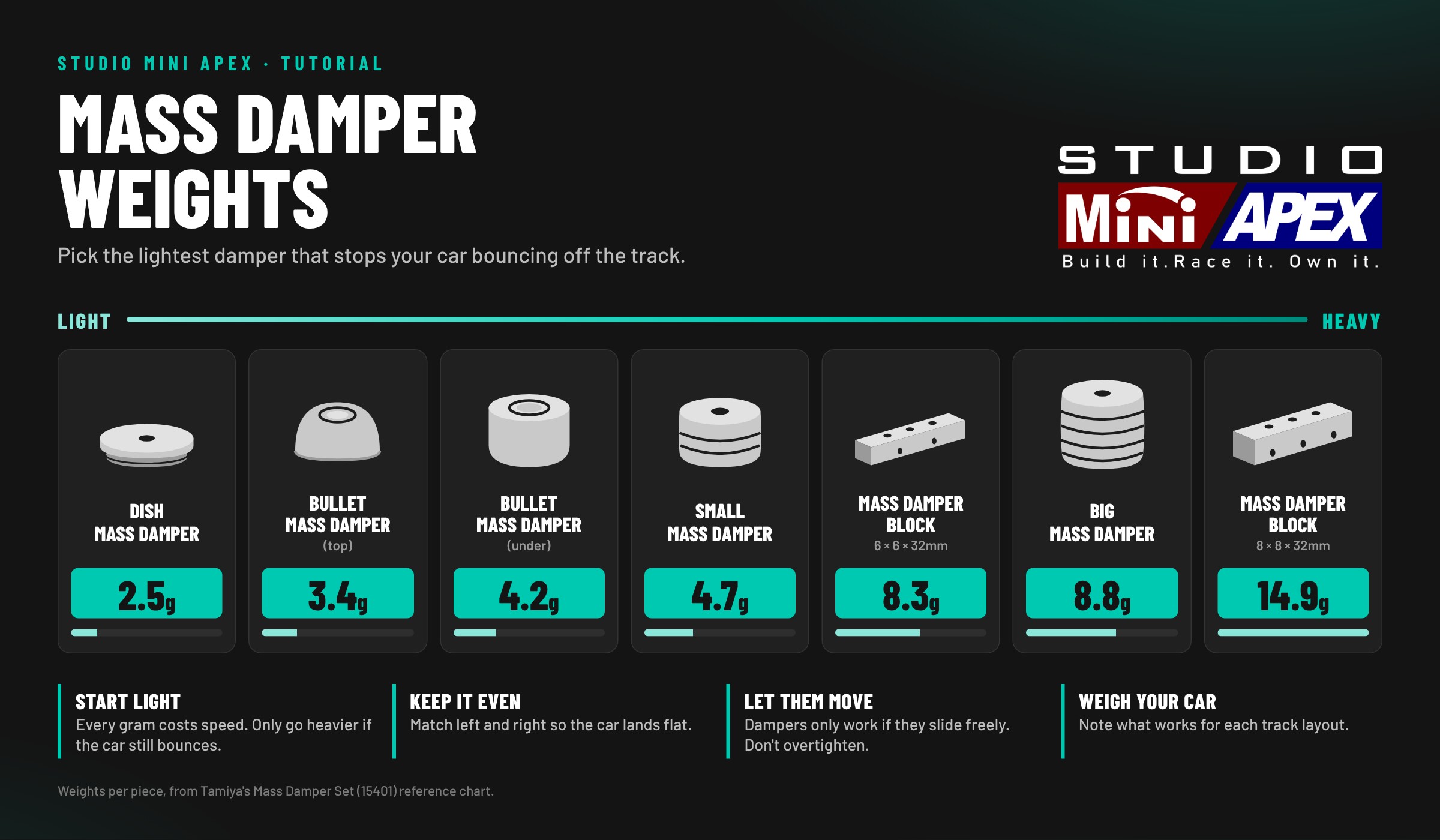
- Start light. Every gram you add costs speed. Begin with small dampers and only go heavier if the car still bounces on landings.
- Keep it balanced. Match left and right so the car lands flat.
- Let them move. Dampers only work if they slide freely. Don’t overtighten the screws.
- Know your weights. The lightest dish damper is 2.5g and the 8x8x32mm block is 14.9g. Put your setup on a scale and note what works for each track layout.
Quick setup order
- Run the car with no brakes and light dampers to see where it fails.
- Flying off on slopes or jumps? Add or lower the rear brake.
- Bouncing out after landing? Add damper weight, a little at a time.
- Re-test after every change, one change at a time.
Brake sponges, plates and mass dampers are on the parts wall. Ask at the counter and we’ll help you dial in your setup at the track.
Source: damper weights from Tamiya’s Mass Damper Set (15401) reference chart, via R-Zone.